This website uses cookies.
Using a few necessary cookies is unavoidable to operate our store. However, you can decide on the cookies used to improve our services and personalize advertisements.
You can read more about cookies here.


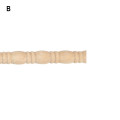
The B-type wooden trim moulding features a classic profile and is mainly used as an interior window trim molding and as a door beading trim. The bobbin beading serves both functional and decorative purposes as it covers joints and gaps. During repairing furniture, it is ideal for refurbishing old or new door and window frames, as natural wood can be easily paired with other materials. These mouldings are easy to work with, paint, or varnish, so their application can be fully customized to your needs.
The carved molding comes in a range of sizes: width from 0.9 cm to 2.0 cm, length from 80 cm to 240 cm, and thickness from 0.4 cm to 0.9 cm; it is available in multiple sizes. The size tolerance is plus or minus 3%. If you order multiple mouldings, we cannot guarantee that the pattern will fit seamlessly into the next piece without cutting. Therefore, to ensure a perfect fit, please calculate and order with a small margin. The pattern of the slat consists of an alternating sequence of one or two rings and an elongated bead. It is made of beech. Beech is one of the most popular European hardwoods, ideal for intricate woodwork. Its dense structure and uniform grain make it suitable for detailed craftsmanship. Its natural color is a pinkish-brown shade which becomes even more attractive over time, and looks especially appealing with oiled or waxed finishes. This product is unfinished.
If you can add the product to your cart, it is in stock and will be shipped shortly after your order is placed. During packaging, our colleagues check the product's quality and only the suitable pieces are packed. The profile of the bobbin beading is widely accepted by cabinetmaker professionals, and its classic pattern makes it highly versatile.
The bobbin beading is an ideal choice for repairing furniture or for frame details of doors or windows. The decorative mouldings for furniture offer a decorative finish, hides joinings, and enhances the overall look. In cabinetmaker projects, it is commonly used to finish cabinet and dresser surfaces. Bobbin beading gives new life to old furniture while preserving its original structure.
Mouldings can be affixed using wood glue (D2 or D3). In this case, the surface should be clean and dust-free. If necessary, it can also be fastened with small nails—the heads should be countersunk and covered with wood filler. It can be glued to non-wood surfaces with a suitable universal adhesive. After gluing, it is recommended to gently press down the moulding until fully dry.
The B-type wooden moulding comes in its natural state, so you can freely choose between varnishing or oiling. Before finishing, make sure the surface is dust-free. Apply varnish in a thin, even coat and let it dry thoroughly. Glossy, satin, or matte varnish all provide lasting protection and an elegant appearance for the decorative mouldings for furniture.
Mouldings have been used since ancient architecture for finishing and decorating structural elements. In classical styles, trim mouldings articulated the façade, windows, and doors. On Renaissance and Baroque furniture, bobbin beading highlighted the frames and divisions. Cabinetmaker artisans still use these techniques in building custom furniture.
The type B wooden trim moulding is a classic patterned strip featuring one or two narrow rings followed by an elongated flat bead. During cabinetmaker projects, it is often used as interior window trim molding or as a decorative mouldings for furniture. It is made of solid wood, making it easy to finish and adaptable to other wooden surfaces when repairing furniture. Order now and decorate your furniture with natural bobbin beadings!
check_circle
check_circle



Comments (0)
Your review appreciation cannot be sent
Report comment
Report sent
Your report cannot be sent