This website uses cookies.
Using a few necessary cookies is unavoidable to operate our store. However, you can decide on the cookies used to improve our services and personalize advertisements.
You can read more about cookies here.


Many people are familiar with the perforated cane webbings and rattan sheets from classic bentwood chairs. Nowadays, rattan panels are getting increasingly popular: they are used as rattan panels or as a decorating material. So it’s no surprise that cane webbings appear frequently on both antique furniture and in modern homes. It is made from a natural material, is well-ventilated, and surprisingly durable. This product can be purchased as rattan sheets, not only in whole rolls. Browse our rattan fabric selection and get inspired by our gallery!
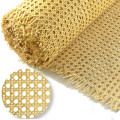
Material: rattan (rattan palm) bark. Pattern: octagonal, density 2 holes / 1 inch. Width: 60 cm, with the weaving strands extending at least 2 cm beyond the nominal width on both sides. Roll length: 15.24 m (50 feet). If you purchase a whole roll of cane webbing rolls, you receive a 10% discount! Quality: first class, strength: NOT intended for chair repair.
Cane webbing rolls are machine-woven, perforated meshes made from the outer bark of the rattan palm. It is a natural material produced from a plant native to tropical Southeast Asia. As it is a rapidly renewable resource, it offers an eco-friendly and sustainable solution. It is favored because it is flexible and durable. Watch our video about using rattan panels!
Rattan sheets are extremely versatile and can be used to refurbish furniture or create new items. They are ideal for chair backs, headboards, rattan wardrobe doors, rattan lampshades, and rattan panels. You can even make rattan radiator covers from them. Its natural texture brings warmth and uniqueness to interiors. Thanks to its perforated structure, this material is also ideal for decorative radiator cover, as they do not reduce heating efficiency. Moreover, decorative radiator cover aesthetically hides the heater and adds stylish appeal to the living space.
Paravans made from rattan panels visually divide spaces. At the same time, they do not close them off completely, preserving the open and airy atmosphere. This solution is especially popular in minimalist and modern style homes. Furthermore, this material can serve as a great option for rattan wardrobe doors; as most often, it is built into cabinet and dresser doors. Since it is easy to handle and shape, these properties make it suitable for crafting rattan lampshades of various shapes.
It depends on the application: for chair backs, the most common method is pressing it into a groove and securing it with a wedge. As it is mostly purchased for decorative purposes, the staple gun method is preferred for rattan wardrobe doors and rattan radiator covers. Attention, proper preparation of rattan sheets is essential! Before installation, soak the rattan fabric in cold water for 15-30 minutes. As a result, it softens, stretches slightly, and becomes flexible and manageable, making it easier to stretch and fit into the frame. When gluing into a groove, do not allow the sheets to dry before the glue sets; keep a damp cloth on it. As it dries, rattan sheets regain their original size and become taut.
Please note that the shiny outer side of the rattan bark absorbs paint and stain with difficulty. It is definitely advisable to test paint a small section first. The best results can be achieved by using a solvent-based lacquer with stain (for example, mixed into shellac or beisen lacquer). Solvent-based lacquers are recommended instead of water-based ones, as the latter may cause rattan sheets to stretch. After drying, check that the finish on rattan fabric is truly wipe-proof from the surface.
This product may also be known as: decorative radiator cover.
The TH-1/2-60-N featured in our selection is one of the premium quality cane webbing rolls. It is made from natural material and has a characteristic an typical octagonal pattern. Its greatest advantage is its lightweight, breathable structure, which guarantees excellent ventilation. Additionally, it brings a natural, warm feel to any interior, making it a popular choice for rattan wardrobe doors insert and rattan panels.
check_circle
check_circle



Comments (0)
Your review appreciation cannot be sent
Report comment
Report sent
Your report cannot be sent