This website uses cookies.
Using a few necessary cookies is unavoidable to operate our store. However, you can decide on the cookies used to improve our services and personalize advertisements.
You can read more about cookies here.


Restoring old cabinets is a cost-effective way to preserve furniture, especially when the repair is done with fine woodworkings. The ready-made carved elements are not only cost-effective but also greatly speed up the vintage furniture repair process. They can be used as a capital of columns or can serve as elegant decoration for cabinets with crown moulding, doors, dressers, and other types of furniture.
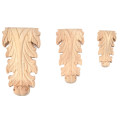
The VK-370A wood ornament's dimensions are: width from 4 cm to 8 cm, height from 8 cm to 14 cm, and thickness from 1.5 cm to 2 cm, depending on the size. The size tolerance is plus or minus 3%. The corintian column capital features an acanthus leaf motif. Material: exotic (rubber) wood. Rubber wood is an environmentally friendly choice as the wood is repurposed for furniture making after latex extraction. It is a medium-hard wood, stable and durable, while remaining relatively easy to work in fine woodworking. Its light, creamy base color can be easily combined with other woods and accepts various surface treatments excellently. It is untreated, in a natural finish.
Today, vintage furniture repair is not exclusive to fine woodworking experts. Even at home, anyone can easily restore their beloved furniture using our carved pieces. These carvings are not made from pressed sawdust but from high-quality wood, resulting in a premium appearance and exceptional durability. They are available in multiple sizes in our selection, so they fit the dimensions of various pieces of furniture.
Our VK-370A carving is often used as a decorative feature on cabinets with crown moulding. It has a natural wood color, so for example by staining it can be easily matched to the cabinet's other surfaces. There is no need for sanding before gluing because we ship the piece already pre-sanded to you. It can be easily glued to a wooden surface using woodworking adhesive.
This carving can serve as an attractive trim ornament for a broader door moulding or a window frame as well. The carving is easy to finish, so you do not have to worry about it being a mismatch with the door color. It can be easily painted, helping you effortlessly bring color to the room. Furthermore, it can be used perfectly as a capital of columns on a feature wall or as a decorative accent on an ornamental fireplace. We dispatch them from stock, so they arrive quickly, and there is no need to wait for carving.
No, carved mouldings can also be fixed with small nails or brads if gluing is not possible for some reason. For mechanical fastening, it is recommended to use small brads or pins, as this way they are less visible and do not damage the wood. It is important to insert the nails into pre-drilled holes to prevent the wood from splitting. The heads should be set below the wood’s surface with a countersink so later the spot can be aesthetically covered with wood filler. This method ensures a secure and lasting way to attach cabinets with crown moulding.
It depends on the desired final result. If, for example, a completely uniform surface is the aim, painting is the right choice. Painted coloring completely covers the original color and wood grain. If, however, you do not want to cover the natural look of the wood, glazing may be a great option since it doesn't hide the original patterns. Instead, the wood absorbs the glaze, providing an extra protective layer. There is also the possibility of varnishing the wood carving, which also preserves the original wood pattern. The wood does not absorb the varnish but it dries on the surface, forming a protective coating. Depending on expertise and preference, it can also be polished with shellac or treated with wood oil.
Florentine Italian masters used the acanthus leaf motif to express the triumph of learning, art, and civilization over barbarism. In Renaissance palaces and villas, acanthus decorations demonstrated sophistication and connection to classical culture, turning the motif into a symbol of intellect and refined taste. Later, on cabinets with crown moulding, the acanthus appeared in a more restrained and naturalistic form. In style, the acanthus leaf motif follows classical principles of proportion and harmony on cabinets, cassone chest decorations, chair backs and tabletops. The acanthus ornaments of this era perfectly reflected Renaissance ideals: the revival of ancient wisdom and the elevation of human creativity through art and knowledge.
In furniture decoration, the corintian column embodies classical harmony and elegance. The capital of columns is a highly detailed piece featuring acanthus leaf motif and vine decorations. Fine woodworking professionals gladly employ this decorative solution when vintage furniture repair requires unique character. It can be found primarily on cabinets with crown moulding, tables, but also on statement furniture pieces.
If you can see and select the second class product, there are also a few second class ornaments made from that carving. These items may have minor defects such as discoloration, warping, or small chips or cracks. If you are interested in our second class products currently in stock, please contact us so that we can provide you with more detailed information and, if requested, photographs of these carvings.
Nowadays, vintage furniture repair is becoming increasingly popular, and our crown profiles make this process easier. The acanthus leaf motif carving is a popular product among fine woodworking professionals because it is meticulously crafted and made from real wood. With their help, vintage furniture repair can be carried out quickly and easily. Installation is very straightforward, as it can be glued onto wood or other surfaces. It can be easily finished, so it can be adapted to any furniture piece.
check_circle
check_circle



Comments (0)
Your review appreciation cannot be sent
Report comment
Report sent
Your report cannot be sent